 9 min read
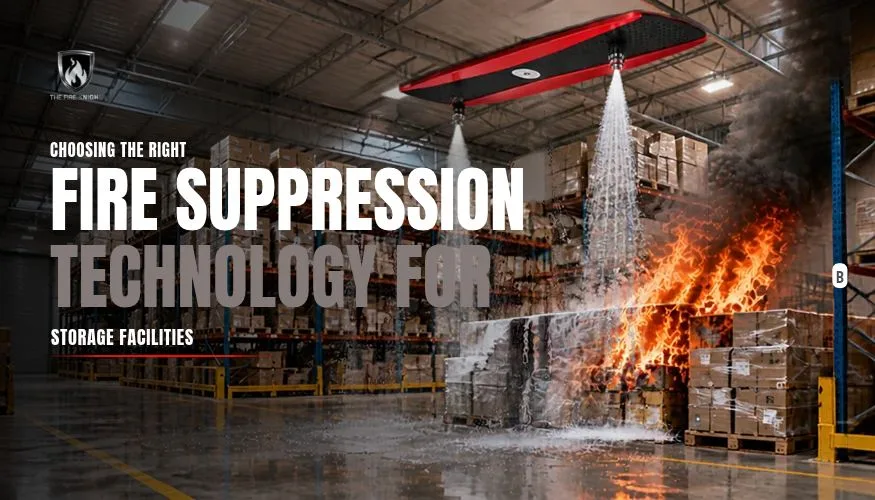
A warehouse fire rarely starts big. It starts as a forklift battery charging at 2 am, a loose connection inside a panel, or a spark landing near shrink-wrapped pallets. Within minutes it can climb a rack, and within hours it can take a dozen fire tenders to bring it under control.
Choosing the right fire suppression technology is how you stop that growth early. No single technology protects an entire storage site, so this guide shows you how to match each one to each zone, using Indian codes and lessons from recent fires.
QUICK ANSWER
The right fire suppression technology for a storage facility depends on four things: what you store, how high and how densely you store it, whether the space is enclosed or open, and whether anyone is present when a fire starts. For most Indian godowns and logistics sheds, automatic sprinklers designed to IS 15105 and NBC 2016 Part 4 protect the storage floor. Special hazards then need a second layer: foam for flammable liquids, clean agent or water mist for records and IT rooms, water-based cooling for lithium batteries, and autonomous local suppression for charging bays, panels, site offices and open yards.
Why storage facilities are a different fire problem
A storage building is fuel arranged in tall stacks. Cartons, film, plastics and textiles create a very high fire load (the heat the contents can release), and the gaps between pallets, called flue spaces, pull flames upward like a chimney.
Many godowns also run with skeleton staff at night and on holidays, so a fire can burn unseen before anyone calls 101.
India still loses thousands of lives to fire each year. The National Crime Records Bureau recorded 7,054 fire accidents and 6,891 deaths in 2023, and 5,971 accidents with 5,888 deaths in 2024. Most deaths happen in homes, but storage fires cause some of the largest property losses:
- Nelamangala, near Bengaluru (May 2025): a 35,000 sq ft lubricant warehouse burned for about 11 hours, with an initial loss estimate of about Rs 30 crore, according to Howden India’s risk engineering newsletter.
- Gurugram (April 2025): a garment warehouse fire spread into neighbouring liquor and shoe warehouses and took more than 20 fire tenders around 12 hours to control.
- Bhiwandi, Thane (June 2025): a chemical godown fire in Val village killed one worker and spread to about a dozen adjoining units.
The common thread is spread. Good suppression design controls a fire before it grows past what one hose can handle.
Five questions to answer before you pick a system
Answer these for every zone before comparing brands.
| Question | Why it matters | What it points to |
|---|---|---|
| 1. What is stored? | Cartons, plastics, solvents and batteries burn differently (commodity classification). | Sprinkler water density, or foam, gas or special cooling. |
| 2. How high is it stacked? | Tall, dense racks shield fire from ceiling water. | Standard sprinklers for low stacks; ESFR or in-rack for high racks. |
| 3. Sealed or open? | Gas only works if the room holds it. | Clean agent for sealed rooms; water-based systems for sheds and yards. |
| 4. Anyone present? | Some agents harm people; empty sites need systems that act alone. | No CO2 in occupied areas; automatic units with remote alerts for unattended zones. |
| 5. Water and power? | Sprinklers need tanks, pumps and power. | Self-contained units where supply is limited. |
Fire suppression technologies compared
Think of these as tools for different jobs.
| Technology | Best for | Watch out for | Indian code |
|---|---|---|---|
| Standard sprinklers (control the fire) | General godowns, cartons, low to medium stacks | Must match commodity and height; goods too close block spray | IS 15105:2021, NBC Part 4 |
| ESFR sprinklers (early suppression, fast response) | High racked storage in large sheds | Very high water demand; limits with solid shelves and open-top bins | IS 15105, with FM Global and NFPA 13 data |
| In-rack sprinklers | Tall racks, high-hazard goods | Forklift damage; harder layout changes | IS 15105 |
| Foam | Lubricants, solvents, paints | Clean-up; foam must suit the liquid | NBC Part 4, insurer conditions |
| Water mist | Archives, compact rooms, machinery spaces | Must be tested for that hazard | IS 15519:2020 |
| Clean agent gas | Records, server and electronics rooms | Needs a sealed room; weak on deep-seated and lithium fires | IS 15493:2021, IS 15517 |
| CO2 flooding | Unoccupied electrical and machinery spaces | Lethal to people at design concentration | IS 15528 |
| Autonomous local suppression | Charging bays, panels, offices, yards, remote godowns | Protects defined zones; supports, never replaces, sprinklers | Supports NBC Part 4 provisions |
| EXPERT TIP ESFR is unforgiving. Solid shelves, open-top bins or obstructions under the heads can stop it working as designed, so have your consultant check your racking against the ESFR listing first. |
Matching the technology to your storage type
| Facility | Primary protection | Second layer |
|---|---|---|
| General godown (FMCG, textiles, cartons) | Sprinklers, hydrants, detection | Local suppression at charging bays and panels |
| High-bay logistics park or fulfilment centre | ESFR or in-rack sprinklers | Panel protection, battery and returns cages |
| Cold storage (insulated panels, refrigeration plant) | Dry or pre-action sprinklers where freezing is a risk, per IS 3594:2024 | Compressor room and panel protection |
| Chemical, paint and lubricant stores | Foam systems, segregation, spill containment | Detection, separation from general stock |
| Records, archives, IT rooms | Clean agent or water mist | Aspirating early-warning detection |
| Lithium-ion stock and returns | Water-based cooling, segregated cut-off rooms | Early heat and gas detection |
| Agricultural godowns (grain, cotton, jute) | Hydrants and sprinklers where required; IS 16144 for foodgrain godowns | Autonomous units with remote alerts |
| Open yards, pallet and scrap stores | Yard hydrants (IS 13039) | Outdoor autonomous suppression |
See where fires start outside the racking on our page on warehouse fire protection for godowns and logistics parks, and every safety layer a site needs in our complete guide to warehouse and godown fire safety systems.
What Indian codes and rules expect
- NBC 2016 Part 4 classifies storage buildings as Group H. Its Table 7 sets minimum firefighting installations by building height and area. The Directorate General Fire Services advised states in 2017 to adopt Part 4, and your state fire service applies it when it issues your fire NOC.
- IS 3594:2024 is the BIS code written for general storage, warehousing and cold storages. Its second revision adds provisions on sprinklers and battery-operated forklifts and aligns with NBC 2016.
- IS 15105:2021 covers sprinklers, IS 2189:2008 detection and alarms, IS 3844 and IS 13039 hydrants, IS 15493 and IS 15528 gas systems, and IS 15519:2020 water mist.
- If your store is part of a factory, Section 38 of the Factories Act 1948 requires precautions against fire.
- Warehouses registered with WDRA must be adequately insured under the 2017 registration rules.
| TIP Some states add their own law on top of NBC, such as the Maharashtra Fire Prevention and Life Safety Measures Act 2006. Always confirm the current rules with your state fire service before design starts. |
Lithium-ion stock needs its own plan
| WARNING: E-commerce returns, e-bikes, power banks and forklift batteries are common in Indian warehouses. A damaged lithium cell can enter thermal runaway, a self-heating reaction that continues without oxygen. Fire engineers report that clean agent gas may knock down flames but does not cool the cells, so fires reignite. Water-based cooling remains the best way to slow spread. Segregate battery stock, charge forklifts only in marked bays, and always call the fire service. |
We cover battery chemistry in more depth in why EV fires are different and how battery fire suppression works.
Common mistakes in Indian warehouses
- Switching to plastics or raising racks without rechecking the sprinkler design.
- Stacking goods up to sprinkler heads. Insurers’ risk engineers typically ask for at least 18 inches (about 450 mm) of clearance.
- Filling flue spaces between pallets, which blocks water from reaching the fire.
- Choosing gas for a large shed that can’t hold the concentration.
- Treating an alarm as suppression. Early fire detection at 3 am helps only if someone acts on it.
- Forgetting the yard, security cabin and panel room, and skipping maintenance once the fire NOC is issued.
Inspection and maintenance checklist
This schedule is typical; follow the IS code, manufacturer and fire NOC conditions where they ask for more.
| Frequency | What to check |
|---|---|
| Weekly | Run main, diesel and jockey pumps; check tank level; confirm control valves are open and locked. |
| Monthly | Look for blocked or damaged heads, blocked hydrants and obstructed aisles. |
| Quarterly | Test alarms, detectors, flow switches, hoses and hydrant valves. |
| Six to twelve months | Full flow test; weigh gas cylinders and test room integrity (IS 15496); service autonomous units; mock drill on every shift. |
| After any change | Review the design when stock, rack height or layout changes. |
Our guide on why regular maintenance of your fire suppression system isn’t optional explains what usually fails first.
Where The Fire Knight fits
Sprinklers, hydrants and alarms remain the backbone of storage protection, and nothing we make replaces them. Our autonomous systems cover the edges: small rooms and outdoor zones where fires often start and the main system is slow to react.
- The Protector suits charging bays, packing rooms and site offices. Each unit covers up to 6 m by 6 m, confirms a fire across flame, heat and gas sensors, then discharges a water-based, non-toxic suppressant.
- The Comodo works inside panels and conveyor drives, where electrical faults grow unseen.
- The Guardian protects open yards and perimeters, covering up to 60 m diameter per unit on solar-supported battery power.
Every unit alerts your team by app, SMS and email, even at night.
EXAMPLE LAYOUT: A 1 LAKH SQ FT SHED IN BHIWANDI (ILLUSTRATIVE)
Picture a shed with 10 m racking, a forklift charging bay, two panel rooms, a security cabin and a pallet yard. A practical design uses ESFR sprinklers over the racks and yard hydrants outside, Protector units over the charging bay and cabin, Comodo units in the main panels, and a Guardian over the pallet yard.
Want this mapped for your own site? Explore our industrial fire suppression systems or read how autonomous fire suppression works.
Summary and next step
Choosing fire suppression for a storage facility is a zone-by-zone decision. Start with what you store and how high you stack it. Protect the floor with properly designed sprinklers and hydrants, add foam, gas or mist only where the hazard calls for it, plan lithium stock separately, then close the gaps at charging bays, panels, offices and yards.
Frequently asked questions
There is no single best system. Most warehouses need sprinklers designed to IS 15105 for the storage floor, plus foam, clean agent or local suppression where special hazards exist.
It depends on height, area and state rules. NBC 2016 Part 4 Table 7 sets minimum installations for storage (Group H) buildings, and your state fire service confirms them during the fire NOC process.
Standard sprinklers control a fire until firefighters arrive. ESFR sprinklers respond faster with far more water to suppress it, often avoiding in-rack sprinklers in high-bay storage.
Usually not. Clean agents need a sealed room, so they suit records, server and electrical rooms rather than large ventilated sheds.
No. They protect defined zones such as charging bays, panels, offices and yards, alongside the sprinklers, hydrants and alarms your building needs.