 5 min read
Late on 5 October 2025, a fire broke out in the trauma ICU of Jaipur’s Sawai Man Singh Hospital. Six critically ill patients died, and officials suspected a short circuit in a storage area. Less than a year earlier, 10 newborns died in an electrical fire in the NICU of Jhansi’s Maharani Laxmi Bai Medical College.
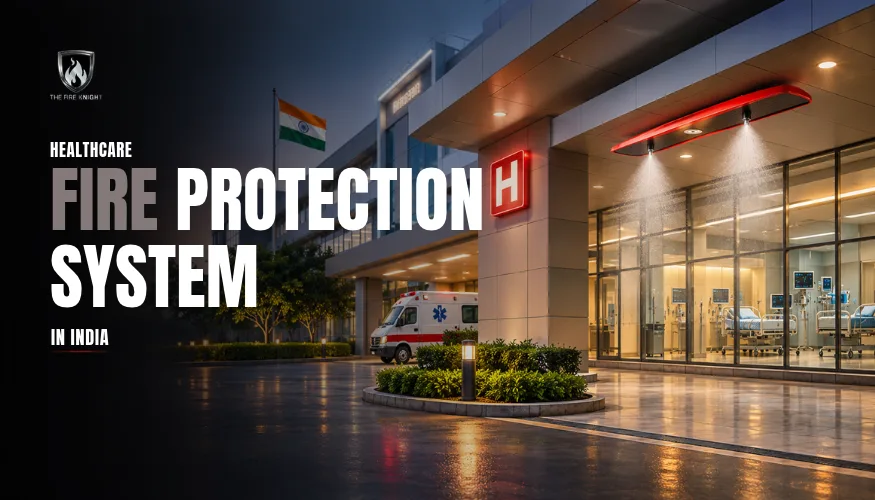
In a hospital, the people at greatest risk are the ones who cannot get up and leave. This guide explains why healthcare fire protection is different, what equipment to have and how to keep it working.
QUICK ANSWER
A healthcare fire protection system combines early detection and alarm, the right extinguishers, sprinklers and hose reels, fire compartments for horizontal evacuation, oxygen shut-off valves and trained staff. In India, hospitals follow NBC 2016 Part 4 and the Health Ministry’s 2026 fire safety guidelines, and need a valid fire NOC.
Why Hospitals Need Special Fire Protection
- Patients who can’t self-evacuate. ICU, NICU and post-operative patients depend on staff and equipment to move.
- Oxygen-enriched air. Extra oxygen makes materials ignite more easily and burn faster.
- Heavy electrical load. Ventilators, monitors, air conditioners and UPS systems run round the clock, often on ageing wiring.
- Combustible stores. Linen, records, plastics and spirit-based chemicals sit close to wards.
Both the Jaipur and Jhansi fires began with electrical faults in critical care areas. That’s where protection needs to be strongest.
What Indian Rules Require
NBC 2016 Part 4 classifies hospitals as Group C (Institutional) buildings and sets their minimum fire protection by height and area. The Directorate General Fire Services has advised states to adopt it, and your state fire service applies it through the fire NOC.
In May 2026, the Health Ministry released the National Guidelines on Fire and Life Safety in Healthcare Facilities (2026). They call for a designated Fire Safety Officer, a Fire Safety Committee, a fire hazard register and fire-hazard assessments at least every quarter. In July 2026, the Ministry asked states to audit every hospital, public and private, and to upload monthly audits on the IHIP portal. The NDMA Hospital Safety Guidelines add guidance on disaster preparedness.
Hospital Fire Protection Equipment Checklist
| Equipment | Where it’s needed | Indian reference |
|---|---|---|
| Smoke and heat detectors, manual call points | Wards, ICUs, OTs, stores, ducts, plant rooms | IS 2189 |
| Fire extinguishers | CO2 or clean agent near electrical equipment; water or ABC elsewhere | IS 2190 |
| Automatic sprinklers | As NBC requires by height and area | IS 15105 |
| Hose reels, wet riser, yard hydrants | Every floor and around the building | IS 3844, IS 13039 |
| Fire doors and compartments | Between wards for horizontal evacuation | NBC 2016 Part 4 |
| Medical gas zone shut-off valves | Outside ICUs, OTs and wards | Hospital fire safety plan |
| Emergency lighting and exit signs | All escape routes and stairs | NBC 2016 Part 4 |
| Evacuation aids | Evacuation sheets, trolleys, a fire lift where required | 2026 MoHFW guidelines |
| EXPERT TIP Plan for horizontal evacuation. Moving a ventilated patient down a staircase is slow and risky, so move patients to the next fire compartment on the same floor first, and train staff in exactly this. |
Maintenance Tips That Keep Systems Working
| Frequency | What to check |
|---|---|
| Every shift | Exits and corridors clear, oxygen cylinders chained, fire panel showing normal |
| Monthly | Extinguisher pressure and tags, hose reels, emergency lights; upload the audit on IHIP |
| Quarterly | Fire-hazard assessment, detector and alarm tests, evacuation drill including night shift |
| Yearly | Electrical audit with thermal scanning, full service of pumps, sprinklers and suppression units |
| After any change | Reassess when a ward, ICU or equipment load is added or moved |
Here’s why regular maintenance of your fire suppression system isn’t optional.
Common Mistakes in Indian Hospitals
- Plugging oxygen concentrators, heaters and chargers into overloaded extension boards.
- Keeping files, linen and cartons in storerooms that open into ICUs.
- Silencing alarms after false alarms and never resetting them.
- Locking fire exits for security, especially at night.
- Having no written plan for moving patients on life support.
- Relying on people to notice smoke. Early fire detection buys the minutes evacuation needs.
Where The Fire Knight Fits
Detection, sprinklers, hydrants and trained staff remain the foundation. Our autonomous fire suppression systems add a fast local response in the service spaces where hospital fires often begin, so a fault is contained before smoke reaches a ward.
- The Comodo works inside electrical panels, UPS and battery cabinets, where faults grow unseen.
- The Protector protects medical stores, records rooms, pantries and plant rooms with a water-based, non-toxic suppressant and instant alerts to the facility team.
See how this is planned across a whole site on our hospital fire safety page.
Protect Patients Before Smoke Reaches The Ward
| REQUEST A CONSULTATION Book A Hospital Site Assessment Start with code-required systems, then close the gaps in panels, stores and plant rooms. Talk to our fire safety team for a site assessment, WhatsApp +91 97142 69162, or find a Fire Knight distributor near you. |
Frequently Asked Questions
Yes, in almost every case. State fire services issue NOCs to hospitals and nursing homes based on NBC 2016 Part 4 and state rules, and they must be renewed on time.
CO2 or clean agent extinguishers suit electrical and medical equipment because they leave no residue. Select and place them as per IS 2190.
Regularly, and on every shift, including nights. The 2026 Health Ministry guidelines and your state fire service set the minimum.