 8 min read
A factory fire is one of the most destructive events a business can face. In seconds, machinery, raw material, finished stock, and years of investment can be lost, and worst of all, lives can be put at risk. According to the National Crime Records Bureau (NCRB), India recorded close to 5,888 fire-accident deaths in 2024, an average of about 16 people every day, with electrical short circuits among the leading causes. Industrial units, with their heavy electrical loads and combustible materials, sit right at the centre of this risk.
The good news is that most factory fires are preventable. This guide, written from a fire-safety consultant’s perspective, breaks down the top five fire risks in Indian factories, explains the regulations you must follow, and gives you a practical prevention checklist you can act on today.
Why Indian Factories Face a Higher Fire Risk
Manufacturing environments combine several hazards that rarely appear together elsewhere: high electrical loads, heat-generating machinery, flammable raw materials, chemical processes, and large open spaces where fire spreads fast. Recent incidents show how severe the outcome can be. The Atchutapuram pharmaceutical unit explosion in Andhra Pradesh in August 2024, reportedly triggered by an electrical fire, killed at least 18 people, while a firecracker unit blast in Virudhunagar, Tamil Nadu, killed ten. Rapid expansion without matching safety planning makes the problem worse.
Understanding where fires start is the first step to stopping them. Here are the five risks that account for most industrial fires in India.
The Top 5 Fire Risks at a Glance
| Risk | Typical Cause | Primary Prevention |
|---|---|---|
| 1. Electrical faults | Overloading, short circuits, poor wiring | Load audits, thermography, RCDs |
| 2. Flammable materials | Improper storage of chemicals and fuels | Segregated, ventilated storage |
| 3. Machinery overheating | Friction, poor maintenance, dust | Preventive maintenance, cleaning |
| 4. Hot work | Welding, cutting, grinding sparks | Hot-work permits, fire watch |
| 5. Poor housekeeping | Waste build-up, blocked exits | Daily housekeeping, clear routes |
1. Electrical Faults and Overloaded Systems
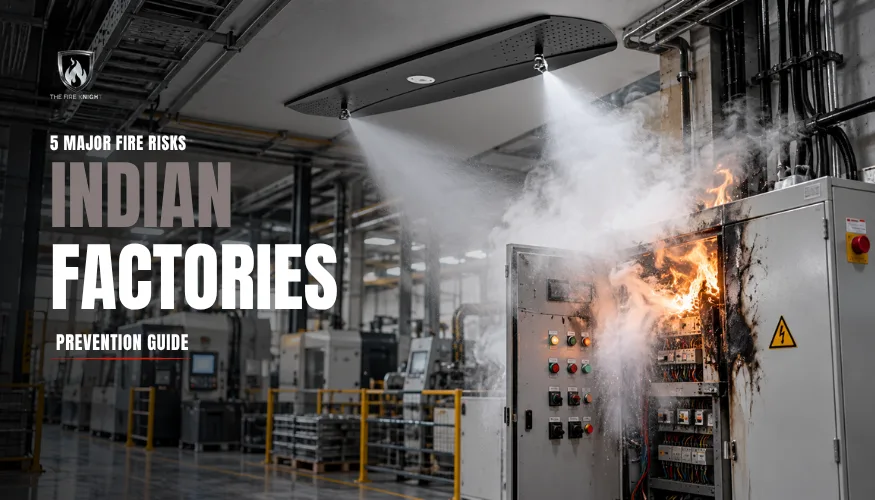
Electrical failure is the single biggest cause of factory fires in India. Overloaded circuits, undersized cables, loose connections, ageing wiring, and unauthorised temporary connections all generate heat that can ignite nearby material. In a plant running heavy motors and continuous shifts, a small fault can smoulder unseen for hours.
How to prevent it
- Carry out periodic electrical load audits and infrared thermography to catch hot spots early.
- Install residual current devices (RCDs) and correctly rated circuit breakers.
- Replace damaged cables and avoid daisy-chained extension boards.
- Ensure all wiring complies with the relevant Bureau of Indian Standards codes.
Because electrical fires often begin before flames are visible, early fire detection around panels and cable routes is your most valuable safeguard.
2. Improper Storage of Flammable and Combustible Materials
Factories routinely hold solvents, fuels, oils, gases, packaging, and chemical feedstock. Stored carelessly, near heat sources, in poorly ventilated rooms, or without spill control, these materials turn a small ignition into a major blaze or explosion. Chemical and pharmaceutical plants face the highest risk.
How to prevent it
- Store hazardous materials in designated, ventilated, fire-rated areas away from ignition sources.
- Follow safety data sheets and the MSIHC Rules for hazardous chemicals.
- Keep quantities on the shop floor to a working minimum.
- Label everything clearly and train staff in safe handling and spill response.
3. Machinery Overheating and Mechanical Failure
Industrial machines run hot. Friction, worn bearings, blocked cooling systems, and accumulated dust or lint can push equipment past safe temperatures. Conveyor systems, motors, boilers, and furnaces are frequent ignition points, especially when maintenance is skipped to keep production running.
How to prevent it
- Follow a documented preventive maintenance schedule for every critical machine.
- Clean dust, lint, and grease from motors, ducts, and cooling fins regularly.
- Monitor equipment temperature and watch for unusual smells or vibration.
- Fit heat and infrared detection near high-risk machinery.
For enclosed high-value equipment such as control panels and server rooms, a compact unit like The Comodo delivers targeted suppression without water damage.
4. Hot Work: Welding, Cutting, and Grinding
Hot work is a leading cause of avoidable industrial fires. Welding sparks and grinding embers can travel several meters and smoulder in hidden material for hours before igniting. Many serious fires start after the work is finished and the area is left unattended.
How to prevent it
- Operate a strict hot-work permit system for all welding, cutting, and grinding.
- Clear combustible material within at least 10 metres of the work area.
- Keep a trained fire watch during the work and for at least 30 to 60 minutes after.
- Keep a suitable extinguisher and a fire suppression aid within immediate reach.
5. Poor Housekeeping and Blocked Escape Routes
Cluttered floors, accumulated waste, oily rags, and blocked exits are a quiet but deadly risk. Waste provides fuel, and blocked routes turn a survivable fire into a fatal one. Many factory-fire deaths happen not from the fire itself but from people being unable to escape, exactly the pattern seen in several recent Indian tragedies where buildings had a single exit.
How to prevent it
- Enforce daily housekeeping and safe disposal of combustible waste and oily rags.
- Keep all escape routes, staircases, and fire exits permanently clear.
- Maintain at least two independent means of escape wherever possible.
- Post clear signage and illuminated exit markings.
Fire Safety Regulations Every Indian Factory Must Follow
Fire safety in Indian factories is a legal mandate, not a choice. The core requirements come from several sources:
- Factories Act, 1948: Section 38 requires every factory to take all practicable measures to prevent the outbreak and spread of fire and to provide safe means of escape. Section 40 covers firefighting equipment, and Section 40B requires a Safety Officer where 1,000 or more workers are employed.
- National Building Code (NBC) Part 4: the Fire and Life Safety code classifies factories as occupancy Group G and sets detection, suppression, and escape requirements.
- BIS Indian Standards: published by the Bureau of Indian Standards, IS 2190 governs portable extinguishers and IS 2189 covers fire detection and alarm systems.
- Fire NOC: a No Objection Certificate from the state fire service, overseen nationally by the Ministry of Home Affairs, is required to operate legally.
Non-compliance can bring fines, imprisonment, suspension of operations, and rejected insurance claims. Preparedness guidance from the National Disaster Management Authority (NDMA) reinforces that prevention and planning save both lives and livelihoods.
Factory Fire Compliance Checklist
| Requirement | Governing Standard | Frequency |
|---|---|---|
| Portable fire extinguishers | IS 2190 / Factories Act s.40 | Monthly check, annual refill |
| Fire detection and alarm | IS 2189 / NBC Part 4 | Periodic function test |
| Fire NOC / licence | State Fire Service | As prescribed (renewable) |
| Safety Officer (1,000+ workers) | Factories Act s.40B | Ongoing |
| Emergency evacuation drill | Factories Act s.38 | At least twice a year |
| Fire safety audit / HIRA | NBC Part 4 / state rules | Annual |
The True Cost of a Factory Fire
The damage from a factory fire goes far beyond burnt stock. For many businesses, operational downtime following a fire often exceeds the direct cost of physical damage. A single serious fire can mean weeks or months of halted production, broken supply contracts, lost customers, regulatory penalties, and, in the worst cases, permanent closure. Add the human cost of injury or loss of life, and the case for prevention becomes overwhelming. This is why detection and suppression should be treated as an investment, not an expense, as we explain in top reasons businesses need advanced fire systems.
Building a Layered Factory Fire Protection Strategy
Prevention alone is never enough. The strongest factories combine prevention with detection and rapid response:
- Risk assessment: map hazards, fire classes, and high-risk zones through a fire safety audit and HIRA.
- Early detection: place multi-sensor, heat, and infrared detection where fires actually start.
- Automated suppression: systems that act in the first seconds slow fire growth before it spreads.
- Emergency planning: clear escape routes, trained staff, and regular drills.
- Maintenance: detection and suppression only work if tested, as covered in why regular maintenance is not optional.
For large plants, outdoor yards, and perimeters, The Guardian provides high-capacity autonomous suppression, while indoor areas are covered by The Protector. For a wider view of workplace hazards, see our guide on common fire risks in commercial buildings.
Conclusion
Factory fires in India are common, costly, and, in most cases, preventable. Electrical faults, flammable storage, machinery overheating, hot work, and poor housekeeping cause the majority of incidents, and every one of them can be controlled with the right mix of prevention, detection, and rapid response. Meeting the Factories Act, NBC Part 4, and BIS standards is the legal baseline, but true safety comes from a proactive, layered strategy that protects your people, your assets, and your future.
The Fire Knight builds autonomous fire detection and suppression aid systems engineered for Indian industrial conditions. To assess your factory’s fire risk, talk to our fire safety experts for a free assessment, or become a distributor to bring The Fire Knight to your region.
Frequently Asked Questions
Electrical faults, including short circuits and overloaded systems, are the leading cause. Regular electrical audits and early detection around panels are the most effective controls.
Yes. A Fire No Objection Certificate from the state fire service is required to operate a factory legally, alongside compliance with the Factories Act and NBC Part 4.
At least twice a year, and more often for high-hazard operations. Section 38 of the Factories Act requires workers to be familiar with escape routes and trained in emergency response.
IS 2190 specifies the type, quantity, placement, and maintenance of portable fire extinguishers, while IS 2189 covers detection and alarm systems.